
Global rating Moody's on Monday affirmed India's long-term local and foreign-currency issuer ratings and the local-currency senior unsecured rating at 'Baa3' with a 'stable' outlook on the back of robust economic growth and sound external position. The rating agency also affirmed India's other short-term local-currency rating at P-3.

Finance Minister Nirmala Sitharaman's biggest challenge will be to find a new growth driver, particularly against the backdrop of a global economy ravaged by heightened uncertainty and fragmentation, financial markets on a precipice, and global commodity prices on a continued uptrend.

Uttar Pradesh, Gujarat and Odisha budgets maintain revenue surpluses despite welfare schemes while Rajasthan and West Bengal face high debt, fiscal deficits and low capital outlay.

CA Sumeet Mehta analyses the Union Budget 2026-2027, identifying key positives and negatives.

The Indian economy recorded a six-quarter high growth of 8.2 per cent in July-September, as factories churned out more products in anticipation of a consumption boost from the GST rate cut, according to government data.

The Indian rupee weakened against the US dollar due to rising crude oil prices, geopolitical tensions in the Middle East, and foreign fund outflows.

The Nifty 50 index could rise around 24 per cent from current levels to 32,032 by December 2026 in a bull-case scenario, Kotak Securities said in a recent note. "We value Nifty at a 10 per cent premium (at 22x) to the 10-year average price-to-earnings of 20x on 2027-28 estimated (E) earnings per share (EPS) of Rs 1,456, and arrive at a December 2026 Nifty target of 32,032," the analysts wrote.

To ensure a glitch-free rollout of the next-generation GST with reduced rates and lesser slabs, Finance Minister Nirmala Sitharaman chaired three separate meetings to assess GSTN's preparedness and the time it would take to implement technological changes required in the software systems.

Asian Development Bank (ADB) on Friday warned that India's limited crude oil reserves of about 100 million barrels - sufficient for only 40-45 days of consumption - leave the country particularly vulnerable to supply disruptions through the Strait of Hormuz amid the ongoing war in West Asia.

Despite a strong 7.8 per cent growth in the first quarter, the Indian economy is expected to grow at 6.5 per cent in the current financial year as the impact of US tariffs on Indian exports will reduce prospects, particularly in the second half, ADB said on Tuesday.

Analysts and economists have hailed the fiscal projections in the interim Budget, saying the lower fiscal deficit forecast shows that the government, even in an election year, is serious about fiscal consolidation and that the numbers look achievable. According to Devendra Kumar Pant, the chief economist at India Ratings, the two broad themes of the interim Budget are fiscal consolidation and stepping up focus on agriculture/rural to course correct, to some extent, the differential benefits of the ongoing economic growth that's tilted in favour of upper-income bracket/urban households. The projected fiscal deficit numbers for FY24 and FY25 suggest that the government is serious about achieving the fiscal consolidation path of 4.5 per cent fiscal deficit by FY26, and given the nominal GDP growth assumption and revenue buoyancy, the target appears plausible, Pant said in a note.

There is increasing evidence that the RBI may well have overreacted in its monetary tightening in 2006, not unlike the 1995 monetary fiasco.

The 'rescue' operation occurred within kilometres of Iran's underground tunnel complex at Isfahan, assessed by the IAEA and US intelligence as holding a substantial portion of the country's 60 per cent enriched uranium stockpile. Retired senior US military officers have highlighted that the mission's footprint -- hundreds of special operators, multiple heavy-lift aircraft deep inside Iran -- appears outsized for recovering a single airman. Prem Panicker continues his must read blog on the Iran War.

'When markets go into a budget with excessive optimism, the risk of disappointment is higher.'

Reiterating Sitharaman's statement that this is a youth power budget, Modi emphasised that the provisions made in the budget will prepare leaders, innovators and creators across different sectors.

The bilateral trade between India and China has been growing at a healthy rate, but the trade gap remains sharply tilted in Beijing's favour. India has time and again flagged its concern over the ballooning trade deficit and the non-trade barriers faced by Indian goods in the Chinese market.
The first thing the new government has to do is to spell out its plan to deal with the mounting fiscal deficit.

India possesses approximately 100 million barrels of commercial crude oil stocks, capable of covering 40-45 days of its requirements if flows through the Strait of Hormuz are disrupted, according to Kpler.

State debt is rising because revenues are disappointingly weak. Ten states have debt ratios exceeding 30 per cent. In 2023-2024, states were borrowing simply to meet day-to-day expenses, points out Debashis Basu.

'We kept this Budget on a larger plank, rather than on one incident, however serious.'

A shift appears underway in India's tax landscape. States with relatively smaller tax collections like Odisha and Telangana are emerging as the fastest-growing contributors to indirect and direct tax collections, respectively.
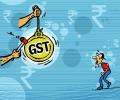
The State Bank of India (SBI) in its latest research report said that reforms in GST through reduction in rates will cause a minimal revenue loss of Rs 3,700 crore. The government estimates the net fiscal impact of GST rates rationalisation will be Rs 48,000 crore on an annualised basis.

New investors should enter gradually and with a long horizon. 'Staggered investment through systematic purchase plans is advisable rather than lump-sum buying.'

'This Budget has a one-year agenda, which you can call the sprint, and the marathon is towards Viksit Bharat.'
The truth about the deficit is that it is designed to serve political objectives, not economic ones.
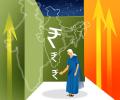
'I will not be surprised if there is a 7 per cent handle in front of the decimal place for the full financial year.'

Many private economists consider the deficit target optimistic, citing weak tax receipts in a sluggish economy and high federal expenditure commitments.

The RBI under new Governor Sanjay Malhotra on Friday cut interest rate for the first time in nearly five years as the central bank pivoted the policy stance to support a shuttering economy. The 25 basis points rate cut to 6.25 per cent comes after last rate reduction in May 2020. The last revision of rates happened in February 2023 when the policy rate was hiked by 25 basis points to 6.5 per cent.

Fitch Ratings on Monday said India's pace of debt reduction is gradual, leaving room for a downside risk to sovereign rating in the eventuality of a significant economic shock. However, the rating agency expressed confidence in India's ability to stick to its medium-term fiscal framework, which aims to reduce debt and bring it on a downward trajectory over time.

India's exports jumped by 19.37 per cent to $38.13 billion in November, while imports dipped by 1.88 per cent to $62.66 billion, according to government data released on Monday.

A new report indicates that increasing unconditional cash transfer schemes for women across 12 Indian states are impacting their fiscal health, with six states projecting revenue deficits.

Finance Minister Nirmala Sitharaman will present her 8th straight Budget and all eyes will be on the much-expected tax relief for the middle class. Sitharaman had in her first Budget in 2019 replaced the leather briefcase -- which had been in use for decades for carrying Budget documents -- with a traditional 'bahi-khata' wrapped in red cloth.

This is the first Budget in my memory of Budgets over the last half a century which has embraced upfront, enthusiastically and emphatically, technology, modernity and fiscal sobriety, notes Shreekant Sambrani.
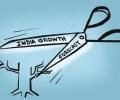
The GDP growth is expected to be about 6.3 per cent in the current fiscal year, a tad lower than the government's estimate of 6.4 per cent, owing to several factors such as weak demand, SBI research report said on Wednesday. According to the first advance estimates (FAE) of National Income for 2024-25 released by the National Statistics Office (NSO), released on Tuesday, India's economic growth rate is estimated to slip to a four-year low of 6.4 per cent in 2024-25, because of poor showing by the manufacturing and subdued investments.
Excise duty cut for auto company is a great boon for the sectors, expert feels.

The challenge before the government now is to use the factors that are favourable to its benefit.
GST Reform 2.0, which trims tax slabs from four to two, signals a push for demand-led growth, and together with recent income tax cuts, sets the stage for sustained economic growth, experts said. The Goods and Services Tax (GST) Council on September 3 approved an overhaul of the indirect tax regime by taxing essentials at 5 per cent and other goods at 18 per cent. A new 40 per cent tax will be applicable on luxury and sin items.

A string of welfare schemes and promises tests the state's budget, which is already heavily dependent on central support and spends little as capital outlay.

India is growing fast, but to keep growing strong, the government must make more things at home, create jobs, and spend money wisely, suggests Rajiv Memani, regional managing partner, Africa-India Region, EY.
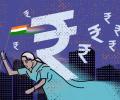
The government's indirect tax collection is expected to increase by 8.3 pc in the financial year 2025-26 (FY26), according to a report by ICICI Bank. The report also noted that this growth is higher than the 7.1 per cent increase seen in FY25 and is mainly driven by rise in GST revenue from strong urban consumption. It said "The increase is driven by higher goods and services tax collections which in-turn is explained by boost to urban consumption".
